
Tips for First Time Home Buyers 2026: Canada Guide

Home sale negotiation
Table of Contents
What Makes 2026 a Strong Year for First Time Home Buyers
How Much Home Can You Afford? Calculating Your Budget
First Home Savings Account (FHSA) Rules for 2026
The 2026 sequencing question: FHSA first, then HBP
Qualifying withdrawal rules that trip people up
What this means for your 2026 budget
Closing Costs for First-Time Buyers: What to Budget
Land transfer tax: the line item that varies most
A worked example: $450,000 purchase
Costs buyers forget
Home Inspection Checklist for Buyers: What to Look For
Navigating Bidding Wars and Conditional Offers in 2026
Post-Closing Maintenance Budgeting and Lifestyle Readiness
Conclusion: Your First-Time Buyer Action Plan
Frequently Asked Questions
Last Updated: Sep 14, 2026
What Makes 2026 a Strong Year for First Time Home Buyers
The expanded First Home Savings Account and revamped Home Buyers' Plan withdrawal limits have reshaped what's possible for home buyers 2026. This guide from Delta Home Inspection Services covers the path from budget to possession.
The FHSA finally has enough contribution room to matter, and HBP withdrawal limits are higher. Combined, these programs give first-time buyers more tax-advantaged capital than at any point in recent memory.
The real advantage in 2026 belongs to buyers who understand property condition before they commit. A house that looks move-in ready can hide foundation, wiring, or roof problems that cost more than any down payment incentive saves.
How Much Home Can You Afford? Calculating Your Budget
Your affordable price range depends on three numbers: gross household income, existing debts, and available down payment. Lenders typically cap your total debt service ratio at around 44% of gross income.
The stress test remains the gatekeeper in 2026. You must qualify at your contract rate plus 2%, or the Bank of Canada's benchmark rate, whichever is higher. A $500,000 mortgage at 5% might require qualifying at 7%, significantly reducing your maximum purchase price.
A common mistake is calculating affordability on sticker price alone. Property tax, heating, and half of any condo fees factor into your debt ratios, so a $450,000 house with high property taxes can qualify for less than a $475,000 house with lower carrying costs.
Use this framework to set your ceiling:
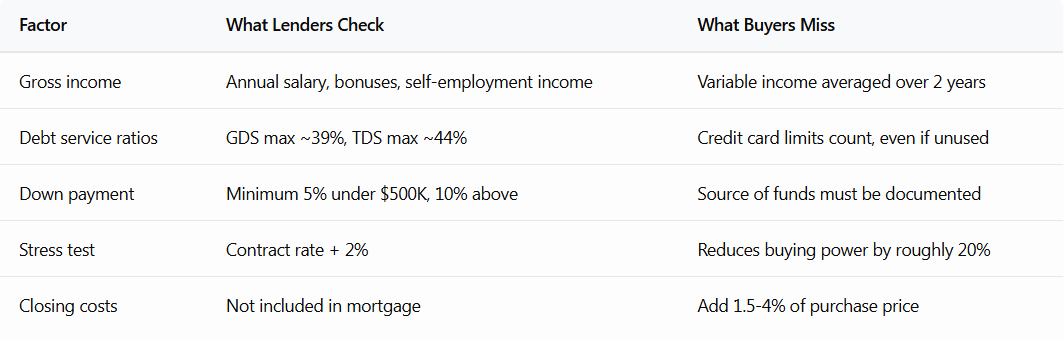
The factors to use to set a house price range
Get a mortgage pre-approval before you shop. It locks your rate for 90-120 days and tells sellers you're serious.
First Home Savings Account (FHSA) Rules for 2026
The First Home Savings Account lets first-time buyers contribute up to $8,000 annually, to a lifetime maximum of $40,000. Contributions are tax-deductible, and qualifying withdrawals for a first home are tax-free.
You can open an FHSA if you're at least 18, a resident, and haven't owned a qualifying home in the current year or the preceding four calendar years. The account stays open 15 years or until you turn 71, whichever comes first.
Unused contribution room carries forward, but only up to $8,000 per year: contribute nothing in year one and you can put in $16,000 in year two. You cannot catch up more than one year at a time.
The 2026 sequencing question: FHSA first, then HBP
The FHSA and the Home Buyers' Plan are not interchangeable, and the order matters. The FHSA is generally the better first dollar: contributions are deductible on the way in and withdrawals are tax-free on the way out. The HBP is a deferral, you withdraw from your RRSP tax-free but must repay over 15 years starting the second year after withdrawal, with after-tax dollars.
A common pattern for a couple in 2026:
Max the FHSA first. Two partners can each hold an FHSA, so a couple can shelter up to $80,000 in lifetime contributions. Open both accounts early so the 15-year clock and annual room start accruing.
Layer the HBP on top. Once FHSA room is exhausted (or if you need liquidity sooner), the HBP lets each eligible buyer withdraw from their RRSP. Confirm the current withdrawal limit with the Canada Revenue Agency's Home Buyers' Plan guide before you plan around it, because the limit has been adjusted in recent years.
Keep the paper trail. Both programs require the funds to be used for a qualifying home purchase, and the CRA can ask you to substantiate the withdrawal.
Qualifying withdrawal rules that trip people up
The 30-day rule. For the FHSA, you generally must have a written agreement to buy or build a qualifying home before you withdraw, and the funds must be used within a reasonable window. Withdrawing before you have a signed purchase agreement can disqualify it.
The four-year lookback. If you or your spouse owned a home in the current year or the four preceding calendar years, you are not a first-time buyer for FHSA purposes, even if you sold it.
The HBP repayment clock. Miss a required annual HBP repayment and the shortfall is added to your taxable income for that year, the most common surprise for buyers who treat the HBP as free money.
Non-qualifying withdrawals. If you take money out of an FHSA for something other than a qualifying home purchase, the withdrawal is taxable and the contribution room is not restored.
Pro Tip: Open your FHSA as early as possible, even if you can only contribute a small amount. The 15-year clock starts on account opening, and contribution room accumulates whether you use it or not. A couple who opens two FHSAs in their early 30s can have both accounts mature well before a typical first purchase.
Watch Out: The FHSA and HBP are not a loophole for buying an investment property. Both programs require the home to be your principal residence, and the CRA can reassess if the property is rented or flipped. Check the CRA's First Home Savings Account rules before you assume your situation qualifies.
What this means for your 2026 budget
If you and a partner each max your FHSA and use the HBP, you can assemble a meaningful down payment from tax-advantaged sources alone. But the HBP repayment schedule becomes a second mortgage payment for 15 years, build it into your post-closing budget before you commit.
Closing Costs for First-Time Buyers: What to Budget
Closing costs typically run 1.5% to 4% of your purchase price. On a $450,000 home, budget $7,000 to $18,000 beyond your down payment. The range is wide because the biggest variable, land transfer tax, depends on where you buy.
Land transfer tax: the line item that varies most
Land transfer tax (or its provincial equivalent) is calculated on a sliding scale based on purchase price, and the scale, rebate, and even the name differ by province:
Ontario: Land Transfer Tax is calculated on a graduated scale, and first-time buyers may qualify for a rebate that offsets a portion of the provincial tax. Municipalities may add their own tax on top.
British Columbia: Property Transfer Tax applies, with a first-time buyer exemption that has a price ceiling, above that ceiling, the exemption shrinks or disappears entirely.
Alberta: No land transfer tax. Instead, a smaller land title transfer fee applies, which is a fraction of what buyers in other provinces pay.
Quebec: A "welcome tax" (taxe de bienvenue) applies, with no broad first-time buyer exemption.
Manitoba, Saskatchewan, and the Atlantic provinces: Each has its own transfer tax or fee structure, and rebate programs change with provincial budgets.
Because these rules change, verify your situation with the provincial finance ministry before finalizing your budget, a rebate that existed last year may have a new ceiling this year.
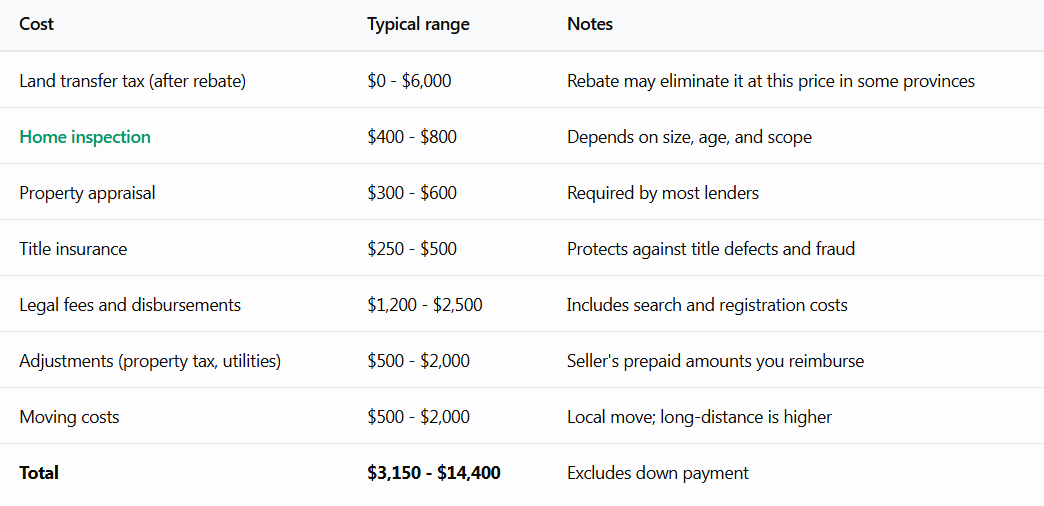
A worked example: $450,000 purchase
Here is a rough framework for a $450,000 home in a province with a mid-range transfer tax and a first-time buyer rebate
Your actual number depends on your province, lender, and how much of the inspection and legal work you shop around for.
Costs buyers forget
Mortgage default insurance. If your down payment is under 20%, your lender will require default insurance, and the premium is typically added to your mortgage balance, but the provincial tax on that premium is paid upfront at closing.
Estoppel certificate fees. If you're buying a condo, the seller's condo corporation charges a fee to prepare the status certificate, and the buyer often covers it.
Utility hookups and deposits. Hydro, gas, and water accounts usually require a deposit or connection fee for new customers.
Home insurance. You need coverage in place on possession day, and the first premium is often due before you get the keys.
Condo status certificate review. Your lawyer will charge to review it, and it's non-negotiable if you want to understand the building's finances.
Watch Out: Never waive a home inspection to make your offer more competitive. The few thousand dollars you save upfront can become tens of thousands in undisclosed repairs after possession.
Key Takeaway: Budget closing costs at the high end of your range, not the low end. The buyers who get squeezed at closing are the ones who spent their entire savings on the down payment and treated closing costs as a rounding error.
Home Inspection Checklist for Buyers: What to Look For
A home inspection is a professional assessment of a property's visible and accessible systems, identifying defects, safety concerns, and maintenance needs before you finalize your purchase.
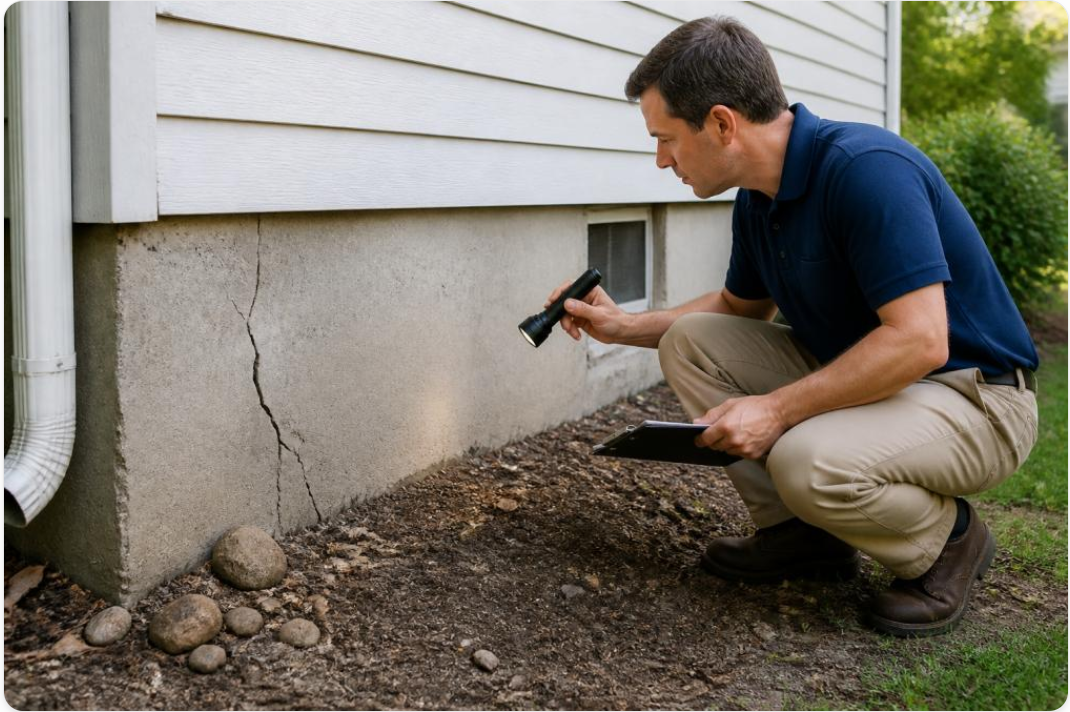
A home inspector checking the foundation
Your inspector should examine these areas:
Foundation and structure: cracks, settling, water penetration signs
Roof: age, shingle condition, flashing, drainage
Electrical: panel capacity, wiring type, GFCI protection, grounding
Plumbing: pipe material, water pressure, drainage, water heater age
HVAC: furnace and AC age, functionality, ductwork condition
Windows and doors: seals, operation, evidence of condensation
Insulation and ventilation: attic, basement, crawl spaces
Exterior: siding, grading, driveway, deck and porch integrity
Safety: smoke detectors, carbon monoxide alarms, handrails
An experienced inspector distinguishes critical issues from cosmetic ones. A cracked driveway is cosmetic. A foundation crack with horizontal displacement is not.
At Delta Home Inspection Services, our Alberta-licensed inspectors deliver interactive reports with photos, videos, and trade recommendations so you know exactly what needs fixing and who to call. We serve Edmonton and surrounding areas up to 100 km away.
Ask your inspector how quickly you'll receive the report. If you're in a bidding situation, turnaround time matters.
Navigating Bidding Wars and Conditional Offers in 2026
A conditional offer includes subject-to clauses that must be satisfied before the sale completes. The most common conditions are financing, home inspection, and condo document review.
In competitive markets, sellers may push for firm offers with no conditions, transferring all risk to you. If the inspection reveals a $30,000 foundation problem, you have no exit.
Here's the practical approach: keep your inspection condition. A seller who won't allow a professional inspection is telling you something. According to Canada Mortgage and Housing Corporation's home buying guide, understanding a property's condition before purchase is essential to protecting your investment.
If you're competing, consider a pre-offer inspection: you pay before submitting, but you can make a firm offer with confidence. It costs more if you lose the bid, but eliminates the biggest risk.
Key Takeaway: A conditional offer with a home inspection clause is your strongest protection. If a seller demands a firm offer, a pre-offer inspection gives you the information to bid safely.
Post-Closing Maintenance Budgeting and Lifestyle Readiness
The costs don't stop at possession. New homeowners should budget 1% to 3% of the purchase price annually for maintenance and repairs.
On a $450,000 home, that's $4,500 to $13,500 per year. Some years you'll spend less. The year the furnace dies, you'll spend more.
Set up a separate maintenance account and fund it monthly, treating it like a bill. Homeowners who don't plan for this end up financing repairs on high-interest credit cards.
Beyond money, consider lifestyle readiness: a larger home means more cleaning, yard work, and sometimes longer commutes. A detached suburban house brings different demands than a downtown condo.
Ask yourself honestly: do you want weekends on maintenance, or would a newer townhome with lower upkeep suit your life better? There's no wrong answer, but there is a wrong match.
Conclusion: Your First-Time Buyer Action Plan
The home buyers 2026 who succeed prepare before they shop. Get pre-approved, max out your FHSA, budget for closing costs, and never skip the inspection.
Frequently Asked Questions
Is 2026 a good year for first-time buyers?
Several factors make 2026 favorable. The First Home Savings Account allows up to $8,000 in annual contributions with a $40,000 lifetime limit, and withdrawals for a qualifying home purchase are tax-free. The Home Buyers' Plan lets you withdraw up to $60,000 from your RRSP. Mortgage default insurance rules and the stress test determine your borrowing capacity, so getting pre-approved early helps you understand your true budget before house hunting.
What is the FHSA contribution limit and how do withdrawals work?
The First Home Savings Account (FHSA) lets you contribute up to $8,000 per year, with a lifetime maximum of $40,000. Contributions are tax-deductible, and qualifying withdrawals for a first home purchase are tax-free. Unused contribution room can carry forward up to $8,000. You must be a first-time home buyer and a resident of Canada to open an FHSA. Funds must be used for a qualifying home purchase by the end of the year following your first qualifying withdrawal.
What closing costs should a first-time buyer budget for?
Closing costs for first-time buyers typically include land transfer tax (rebates may apply for first-time buyers), title insurance, property appraisal fees, home inspection fees, legal fees, and utility adjustments. Budget roughly 1.5% to 4% of the purchase price. Request a cost breakdown from your lawyer early so you are not caught short on closing day. Some costs, like the home inspection, are paid before closing and are not part of your mortgage.
What should I look for during a professional home inspection?
A home inspection checklist for buyers should cover the roof, foundation, electrical panel, plumbing, HVAC systems, windows, insulation, and evidence of water damage or pests. Ask the inspector to distinguish critical safety issues from cosmetic concerns. A thorough report with photos and video helps you prioritize repairs and negotiate with the seller. Attend the inspection if possible so you can ask questions on site.
How do I navigate a bidding war without overpaying?
Set a firm maximum price before making an offer and stick to it. A pre-approval letter strengthens your position. Consider including a home inspection condition even in competitive situations; a conditional offer protects you from hidden structural or mechanical problems. If you waive conditions to win, budget for a post-offer inspection immediately. Working with a real estate agent who knows the local market helps you judge fair value.
What is the First-Time Home Buyer Incentive and do I qualify?
The First-Time Home Buyer Incentive is a shared-equity mortgage program that reduces your monthly payments by providing 5% or 10% of the home's purchase price. Eligibility depends on your household income and the total borrowing amount, which cannot exceed four times your qualifying income. The incentive must be repaid when you sell the home or after 25 years. Check the current program status and qualifying criteria before relying on it for your budget.
Buying your first home is exciting, but it comes with real risk. Before you commit to any property, you need a clear picture of its condition. Delta Home Inspection Services provides Alberta-licensed, NAIT-certified inspectors who deliver interactive reports with photos, videos, and specific trade recommendations. We serve Edmonton and surrounding areas up to 100 km away. Get a quote and know exactly what you're buying before you sign.
